The different deal types in the pharma, medtech and biotech industry, from global to local, across therapy areas and across industry sectors, are a direct reflection of how complex these industries are.
Part of that complexity is the risk and uncertainty involved in developing new health technologies, and the cost and the time it takes to bring an asset from R&D to commercialisation. To thrive, companies need to collaborate, innovate, and adapt to the competitive and dynamic environment.
David Scott set out the deal types for the participants of his 1-day Pharmaceutical Out-licensing Course. The slides define each one, and show what each type means for the partner taking it on.
Two families of deal types
David Scott separates the deal types into two groups.
One-way deals, where rights or responsibilities pass from one company to the other: acquisition, licensing, distribution, and agency. He flags two of these. Agency, he notes, is not really a licensing deal at all. And some agreements that are called distribution agreements are licensing deals.
Collaborative ventures, where two companies work on the same product together: joint ventures, co-promotion and co-marketing.
What the deal type means for the licensee
The deal type determines four things: who does the work, the capital costs, the unit costs, and the degree of control. The deck sets these factors out as a range:
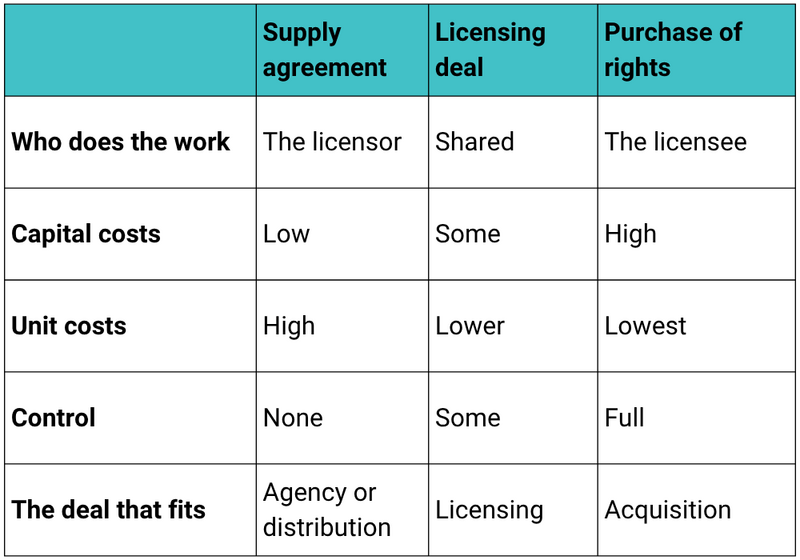
The more of the work and the capital the licensee takes on, the less they pay for each unit they sell, and the more control they hold.
Co-marketing versus co-promotion
The two terms sound alike and are sometimes misunderstood. Co-marketing is the same product sold under different brands, sometimes in different formulations. Co-promotion is one brand with two sales forces behind it.
The deck compares the two point by point. Co-marketing is flexible, but it gives you low control and puts a competitor in the market. Co-promotion builds a single brand, but it ties your image to your partner's and needs extensive coordination. The deck also notes that the choice is not always available, because regulatory and licensing constraints can rule one of them out.
What is in the slide snapshot
A way to think about which deal type fits: what each one costs in capital, in unit price and in control
Every deal type defined: acquisition, licensing, distribution, agency, joint venture, co-development, co-promotion and co-marketing
What an acquisition includes that a licence does not, and how an earn-out works
Co-marketing and co-promotion compared point by point
Download the slide snapshot
Who made this snapshot
David Scott is a recognised authority in pharmaceutical business development and licensing. He was a senior BD&L executive in pharma before becoming a senior BD&L consultant in 1996, and has negotiated licensing agreements across small molecules, biologics and delivery technologies.
He wrote Scrip's Practical Guide to Pharmaceutical Licensing. Participants know him for a no-nonsense, hands-on teaching style.

Continue your learning from David
If you’d like to learn more from David, CELforPharma also offers a 1-day, hands-on course where you'll:
- Understand the overall out-licensing process and key decision points
- Learn how companies decide which type of deal to pursue
- Get introduced to valuation concepts using the rNPV model
- Gain clarity on common legal agreements and term sheet elements
- Understand how to prepare for partner identification and engagement
The Pharmaceutical Out-licensing Course
With David Scott

Don’t miss the latest insights from our expert faculty
Subscribe to our newsletter to:
- Stay on top of the latest expert insights
- Receive invitations to upcoming educational webinars
- Get updates on our courses and training programmes