By Prof. Dr Lieven Annemans, expert trainer of the courses Health Economics for Non-Health-Economists, Basics of Health Economics, and Critical New HTA Developments in Europe: Challenges & Solutions
QALY stands for Quality Adjusted Life Year.
Health economists use the QALY to measure the health effect of a medical treatment or a prevention programme. And payers use it to decide how to spend their healthcare budget.
The Calculation
To calculate QALYs, you multiply the years of life by the quality of life during those years. Quality of life is expressed as a utility value between 0 and 1: 1 means perfect health and 0 means death.
Years of life × utility value = QALYs
Three simple examples:
One year in perfect health gives 1 QALY: 1 × 1 = 1.
Half a year in perfect health gives 0.5 QALYs: 0.5 × 1 = 0.5.
One year at half of perfect health, a utility of 0.5, also gives 0.5 QALYs: 1 × 0.5 = 0.5.
Comparing a new medicine with the current one
Cost-effectiveness studies, also called health economic evaluations, use QALYs to measure the health effect of a new medicine compared with the current one. The current standard of care is the starting point, and only the extra QALYs from the new medicine are counted.
Example
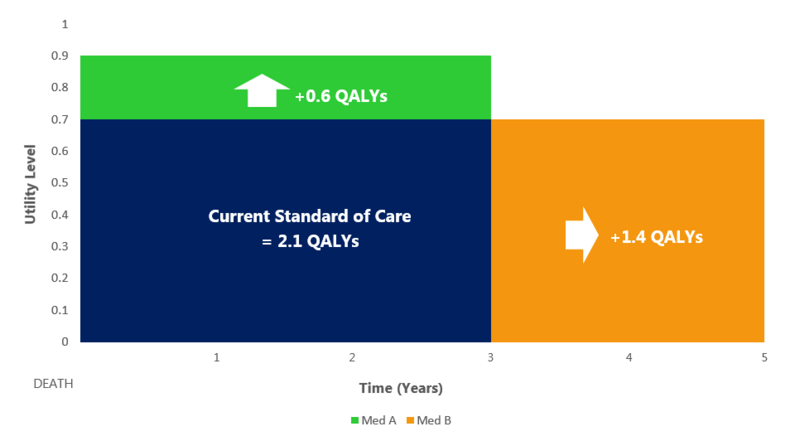
A patient lives 3 years with a disease. With the current standard of care, their utility is 0.7. That gives 3 × 0.7 = 2.1 QALYs.
Medicine A improves quality of life. The patient’s utility rises from 0.7 to 0.9, so they now have 3 × 0.9 = 2.7 QALYs. Medicine A adds 0.6 QALYs: 3 years × 0.2 extra utility.
Medicine B extends life. The patient lives 2 years longer, at a utility of 0.7. Medicine B adds 2 × 0.7 = 1.4 QALYs.
Why the QALY is so useful
Quality of life is measured on the same scale for every disease. This is what makes the QALY so powerful: you can compare the health gain of a new cancer therapy with that of a new antidepressant, or of any other medical treatment.
Test yourself
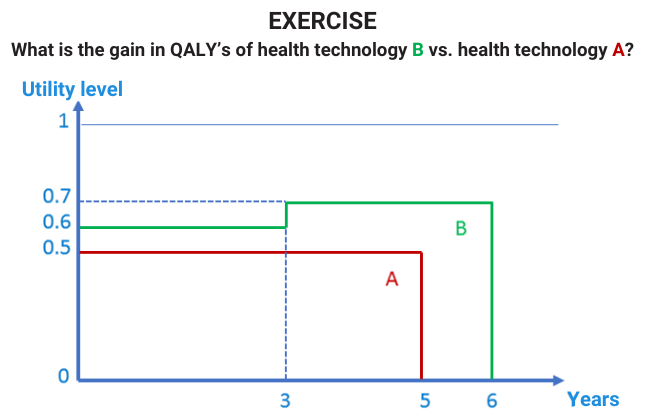
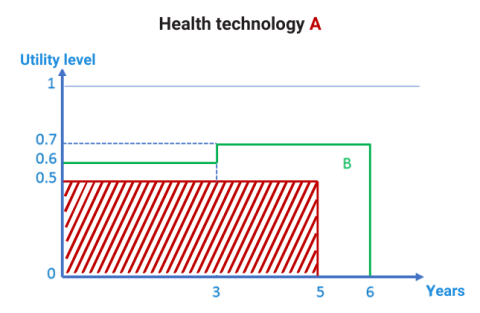
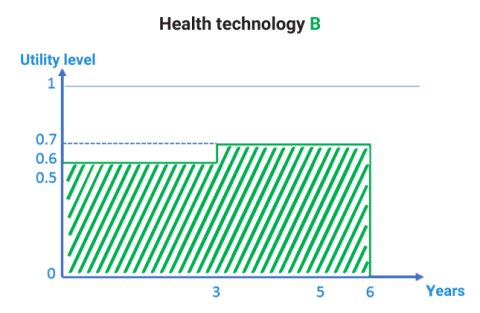
The QALY gain of medicine B over medicine A is the difference between the two areas in the graph:
Medicine A: 5 × 0.5 = 2.5 QALYs
Medicine B: 6 × 0.7 − 3 × 0.1 = 3.9 QALYs
Difference: 1.4 QALYs
Image
Image
The QALY is one of 16 terms in our health economics glossary, free to download. → Health economics glossary: key terms you need to know |
Continue your learning from Prof. Dr Lieven Annemans
If you’d like to learn more from Prof. Dr Lieven Annemans, CELforPharma also offers 3 courses:
2-day course in Brussels:
Health Economics for Non-Health-Economists
With Prof. Dr Lieven Annemans

1-day live online course:
Basics of Health Economics
With Prof. Dr Lieven Annemans
1-day live online course:
Critical New HTA Developments in Europe: Challenges & Solutions
With Prof. Dr Lieven Annemans
Don’t miss the latest insights from our expert faculty
Subscribe to our newsletter to:
- Stay on top of the latest expert insights
- Receive invitations to upcoming educational webinars
- Get updates on our courses and training programmes