Medical Affairs has a toolbox filled to the brim with useful, value-adding, impactful tactics. Advisory boards, CME and symposia are the most well-known, but there are many other activities Medical Affairs can use to have a positive impact on healthcare and on the success of the company.
But how do you decide which of those tactics to use in which situation?
Maaike Addicks, MD, has written this guide for the participants of her The Medical Plan and Tactical Implementation course.
It gives you a way to think about that choice, based on impact and reach, and then applies it to eight Medical Affairs tactics: each one scored on reach, impact and effort, with the outcomes it can produce and an explanation of how it works in practice.
The impact and reach matrix
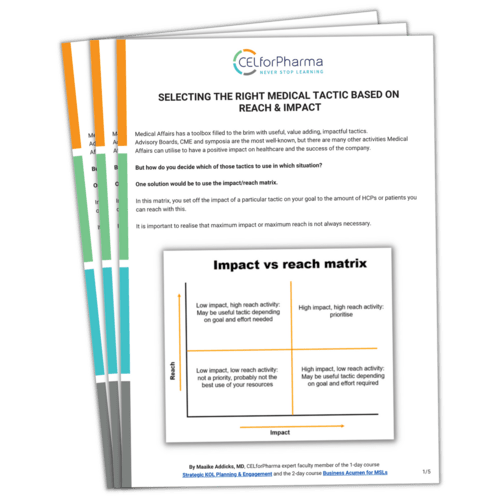
The matrix sets the impact a tactic can have on your goal against the number of HCPs or patients it lets you reach. Neither of the two has to be at its maximum for a tactic to be the right choice.
If the scientific information you are communicating is fairly simple, the impact does not need to be high. A CME or a short webinar may be enough. If the information is more complex or new, you need a higher impact activity, such as a face-to-face meeting or a symposium with a high-profile speaker.
Reach works the same way. Sometimes reaching a few stakeholders is enough, and face-to-face meetings will do. If you need to reach a large number of HCPs, for instance to tell every GP in your country that medication adherence matters, then a tactic with higher reach is the better choice: eLearning, a recorded webinar, or a brochure.
Three tactics from the guide
The guide scores eight tactics this way, and adds the possible outcomes of each. Here are three examples:
| Tactic | Reach | Impact |
|---|---|---|
| Face-to-face discussion | Low | High |
| Symposium | High, depending on audience size | Medium to high, depending on topic, speakers and format |
| CME | Low or high. Live: low e-learning: high | Medium or low. Live: medium e-learning: low |
Effort is the third question
Besides impact and reach, you also need to weigh how much work, time and money a tactic takes to do well. Two tactics can sit in almost the same place on the matrix and still cost you very differently. A face-to-face discussion and a speaker tour both have high impact and limited reach, but one of them takes an afternoon and the other takes months.
That is the sentence worth keeping. It rules out more activity than the matrix itself does.
What's in the guide
A way to decide which tactic fits which situation, weighing impact, reach and effort against each other
Eight Medical Affairs tactics, from a face-to-face discussion to a full medical project, scored on all three
The possible outcomes of each, from insights and network building to establishing the company as a scientific partner
Two pages explaining how each tactic works in practice: who presents, who is paid fair market value, how long it runs, what needs internal approval
Download the guide
Who wrote this guide
Maaike Addicks, MD, is an independent Medical Affairs consultant with more than 15 years across biotech, mid-sized and large pharma, in a range of therapeutic areas. She is a medical doctor and her work centres on strategic Medical Affairs development, change management and competency building.
She is President of the Medical Affairs Commission of the NVFG, the Dutch Association of Pharmaceutical Medicine. Participants know her for turning strategy into something a Medical Affairs team can actually execute.

Continue your learning from Maaike
If you’d like to learn more from Maaike, CELforPharma also offers a 1-day, hands-on course where you'll learn how to:
- Understand the strategic importance of a Medical Plan and its core building blocks
- See how a strong Medical Plan enables successful engagement with internal and external stakeholders
- Select, plan, and execute Medical Affairs tactics that effectively implement the Medical Plan
- Assess the ROI of Medical Affairs tactics to ensure activities contribute real value
The Medical Plan and Tactical Implementation
With Maaike Addicks, MD

Don’t miss the latest insights from our expert faculty
Subscribe to our newsletter to:
- Stay on top of the latest expert insights
- Receive invitations to upcoming educational webinars
- Get updates on our courses and training programmes